
IBM Aspera for Media & Entertainment
IBM Aspera | Media & Entertainment
The render’s done. The edit’s locked. Now you’ve just got to get 4 terabytes across the Atlantic by Tuesday.

Every deadline in media is really a transfer deadline wearing a disguise.
The colourist can be a genius, the edit can be flawless, the broadcast can be sold out. And none of it matters if the file is still inching across the network at 9am on delivery day. The work is finished long before it arrives, and the wait in between is the least glamorous part of show business nobody warns you about.
The files keep getting heavier. The deadlines don’t care.
A feature used to fit on a drive you could courier. Now a single 8K master with its uncompressed audio, its VFX plates, its forty versions, is a small data centre’s worth of content that has to be in three countries by morning. Streaming raised the bar and never lowered it. Live events compressed the timeline to zero.
And the tools most of the industry still leans on – FTP, consumer cloud, the trusty drive in a bag – were built for a world that stopped existing about three resolutions ago. They slow to a crawl over distance, collapse on a flaky connection, and restart from the beginning with a cheerfulness that’s genuinely hard to forgive.
What actually keeps media teams up at night.
Strip it back and it’s always the same four fears. Will it arrive in time? Because the slot is the slot and the festival won’t wait. Will it arrive at all? Because a transfer that fails at 94% over a transatlantic link at 2am is its own special kind of nightmare. Will it leak? Because an embargoed master in the wrong hands is a front-page story and a lost contract. And what’s it costing us? Because when every gigabyte has a price, and you’re moving millions of them, “we’ll just upload it” turns out to have a number attached.
For an industry that runs on deadlines, it's remarkable how much of the pipeline still depends on a transfer method nobody would design on purpose today.
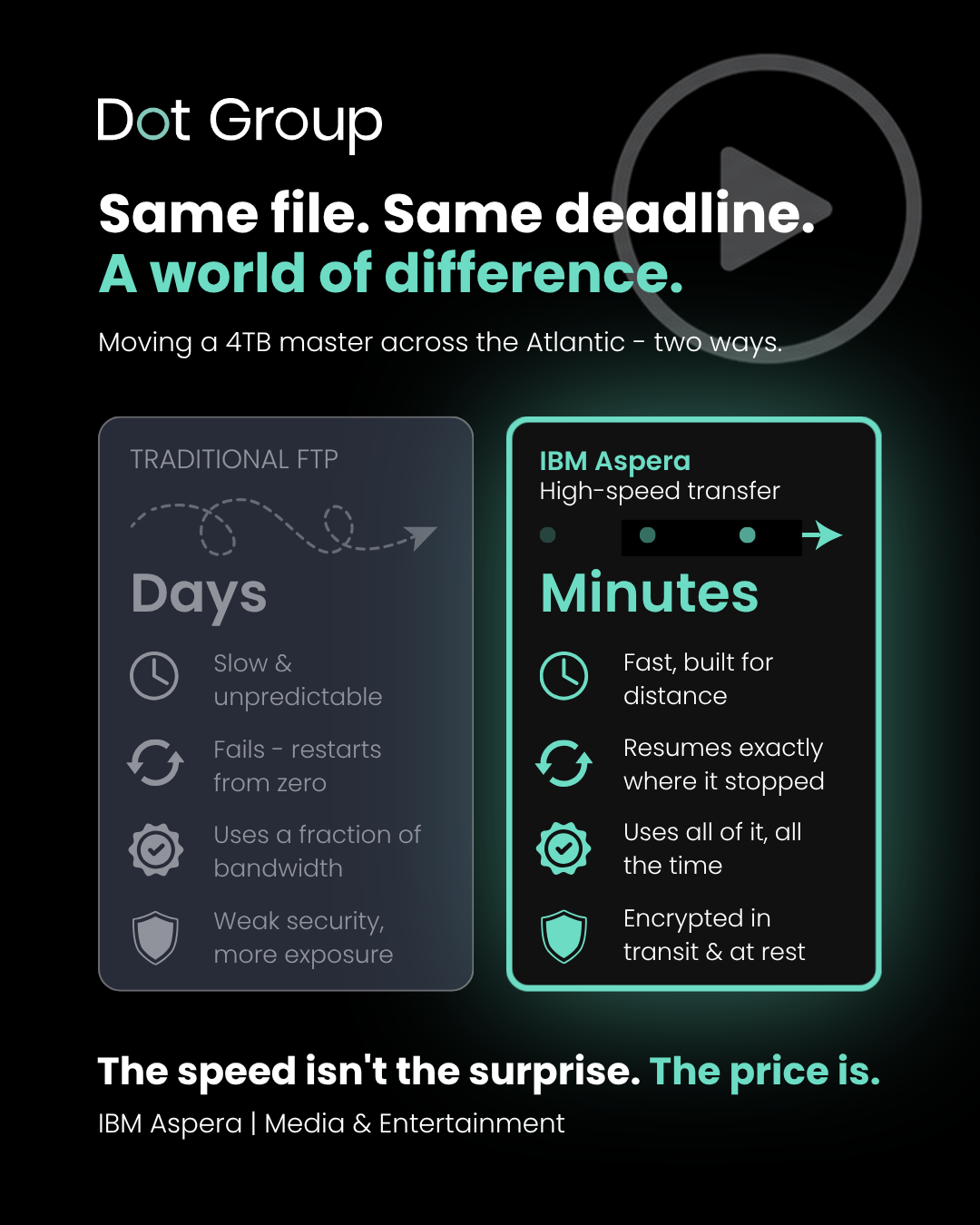
There’s a better way to move a file. And it’s been hiding in plain sight.
The technology that fixes this isn’t new, exactly – the world’s biggest broadcasters and studios have used it for years. It’s just been out of reach for everyone else. IBM Aspera’s patented FASP™ protocol does something almost rude to FTP: it uses all of your bandwidth, all the time, no matter how far the file is going or how temperamental the network is. The transfer that took two days takes twenty minutes. If the connection drops, it resumes exactly where it left off instead of sulking back to zero. Everything is encrypted in transit and at rest, with every block verified, so the embargoed master stays embargoed. And because pricing isn’t tied to volume, moving a petabyte costs what you’d expect, not whatever the meter happened to land on.
It’s why so much of the industry quietly runs on it. The world’s biggest broadcasters, studios and post houses have trusted Aspera for years to move their most valuable content, from live sport turned around against the clock to feature masters crossing continents overnight.
If you thought this was always the preserve of the broadcast giants, you’d have been right, once. Aspera’s old volume-based pricing meant the more you moved, the more it cost, which put it out of reach for the post houses and production companies that needed it most. That’s the part that’s changed: IBM has removed volume-based pricing, so the capability the big studios rely on is now genuinely within reach of a growing facility. Same performance. The barrier that ruled it out is simply gone.
How Viapass moves broadcast files from anywhere, fast.
Viapass operates in event broadcasting – high-pressure, deadline-driven, with massive files arriving from any location in the world and no margin for a transfer that crawls or fails. Traditional methods couldn’t keep up with the speed or the scale the work demanded.
Viapass isn’t alone. The same technology moves content for some of the most demanding operations in the business – FOX Sports sent over 2 petabytes between Russia and Los Angeles during the 2018 World Cup, with under ten seconds from live action to editable footage; FILMFEST MÜNCHEN moved 150 films from more than 50 countries with zero cancellations; base turns sports-broadcast delivery from days into minutes for 80+ global partners; and DMC dispatches its ten-plus daily shows five times faster than before.
The bit other people skip.
Aspera is brilliant. It’s also not a thing you double-click and forget. It almost always has to replace something – an FTP server held together with hope, a managed-transfer tool nobody likes, a workflow with an alarming number of manual steps – and slot into live systems without taking the edit suite offline mid-grade. Getting that right is its own craft: sizing it properly, wiring it into the tools your team already lives in, and staying on the line long after go-live. It’s the part Dot Group has spent years getting good at. Quietly, in the background, which is exactly where this kind of thing belongs.
Which deadline are you quietly dreading right now?