IBM Aspera for Life Sciences & Pharma
The sequencer finishes in hours. Getting the results to the people who need them can still take weeks.

In life sciences, the bottleneck is rarely the science. It’s the distance between where the data is made and where it needs to be.
A genome can be sequenced before morning. A cancer study can generate terabytes before lunch. Modern science is extraordinarily fast at producing data. But then, far too often, it stops, because the results have to travel. They sit in a queue, crawl across a slow link, or go in the post on a physical drive, and the discovery waits on the delivery. The work was finished days ago. It just hasn’t arrived yet.
Every breakthrough comes with a bigger payload.
Each advance in life sciences is also an advance in how much data it generates. Next-generation sequencing, high-resolution imaging, drug-discovery pipelines – all of them produce more, and the curve only steepens. What was gigabytes a few years ago is petabytes now. And none of it stays still: results move between labs, hospitals, universities and cloud platforms, routinely across borders, frequently between organisations that have never shared a network. Much of the sector still leans on FTP, or a courier and a drive. Tools built for a smaller, more local world, that lose packets over distance and fail in ways measured in lost days.
Four questions every research team is quietly asking.
Will it get there in time? A collaboration waiting weeks for a dataset is a collaboration not happening. And grant clocks don’t pause for slow transfers. Will it arrive intact? A corrupted genome or a half-delivered imaging set isn’t an inconvenience; it’s invalid science. Will it stay protected? Patient data and unpublished IP carry HIPAA, GDPR and ISO obligations, and a breach is a catastrophe, not a footnote. And can we even handle this much? When one study runs to thousands of terabytes, “we’ll find a way to send it” stops being a plan.
For a field defined by precision and speed, it's striking how much of its data still travels on infrastructure that offers neither.
The frontier labs already solved this.
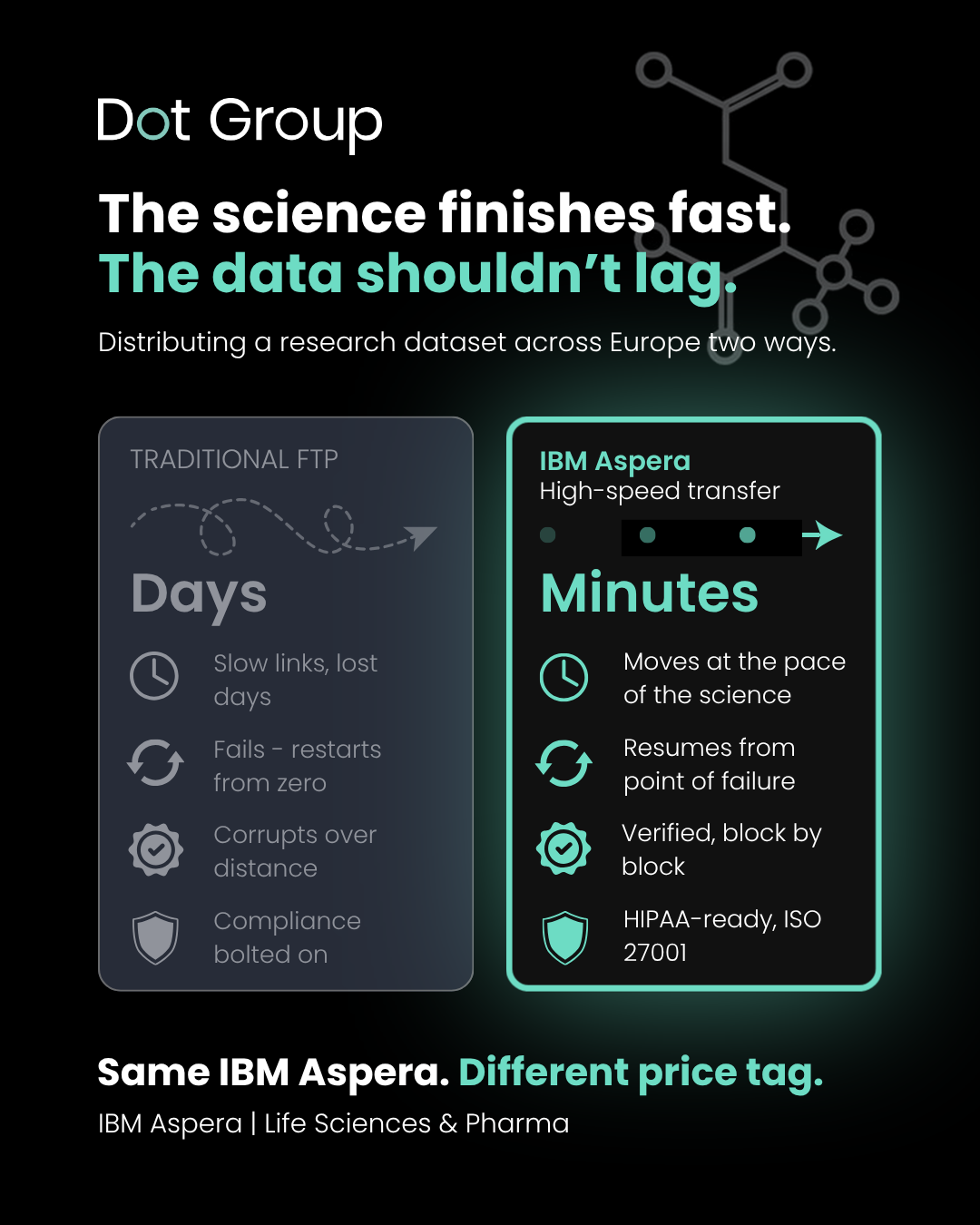
The answer isn’t new. The world’s leading research institutions have used it for years. IBM Aspera’s patented FASP™ protocol uses the full available bandwidth whatever the file size, distance, or network condition, so data moves at the pace the science actually needs. Interrupted transfers resume from the point of failure, not the beginning which matters at 30GB a genome. And it’s encrypted in transit and at rest with integrity verification on every block, HIPAA-ready and ISO 27001 certified, so compliance is built in rather than bolted on.
If your instinct is that this was always the preserve of the big institutions, you’d have been right, once. Aspera’s old volume-based pricing meant the more you moved, the more it cost, which put it out of reach for most labs at exactly the scale they needed it. That’s the part that’s changed: IBM has removed volume-based pricing, so the capability EMBL relies on is now genuinely within reach of a growing lab or a mid-size pharma. Same performance. The barrier that ruled it out is simply gone.
How EMBL distributes 10,000 terabytes a year.
The European Molecular Biology Laboratory, Europe’s flagship life sciences institution, needed to distribute terabytes of research files to a sprawling network of labs, hospitals and universities across Europe and beyond. Physical shipment and FTP were too slow and too exposed: deliveries took days or weeks and degraded over distance.
With Aspera’s Connect Server, EMBL now moves 10,000 terabytes a year at up to 100 times its previous speed, with large datasets arriving in hours instead of days, embedded into its existing infrastructure and deployed in under two days.
The Aspera technology proved to be not only fast and reliable, but also secure, as the sensitive data can be encrypted at rest and in transit.
Senior Engineer Automation, EMBL
The quiet part: making it fit.
Aspera is the capability; fitting it into a working research environment is the craft. It almost always replaces something – an ageing FTP server, a manual process, a workflow held together by goodwill – and has to slot into live systems without interrupting studies that can’t simply pause. That’s where Dot Group comes in: sizing the right deployment, wiring high-speed transfer into the portals and pipelines researchers already use, and supporting it long-term, so the science speeds up and nobody has to think about the plumbing.
What's the dataset your team is waiting on right now?
Tell us about moving research data at the speed your science deserves – securely, compliantly, and at a cost that finally makes sense.