IBM Aspera for Oil, Gas & Energy
IBM Aspera | Oil, Gas & Energy
The survey took weeks and cost millions. Now it just has to travel from the middle of nowhere to a server somewhere else.

In energy, the data is generated in the most remote places on earth. And it’s worth nothing until it reaches the people who can read it.
A seismic survey is one of the most expensive datasets a business can create. Vessels, sensors, crews, weeks at sea or in the field and the result is terabytes of data sitting on a drive in a place with barely a phone signal, let alone fibre. The exploration happens at the edge of the map; the interpretation happens in an office thousands of miles away. Between those two points is a transfer problem that can hold up a multi-million-pound decision, and the old answer – ship the drive and hope – belongs to a different era.
The data is huge, the locations are hostile, and the clock is expensive.
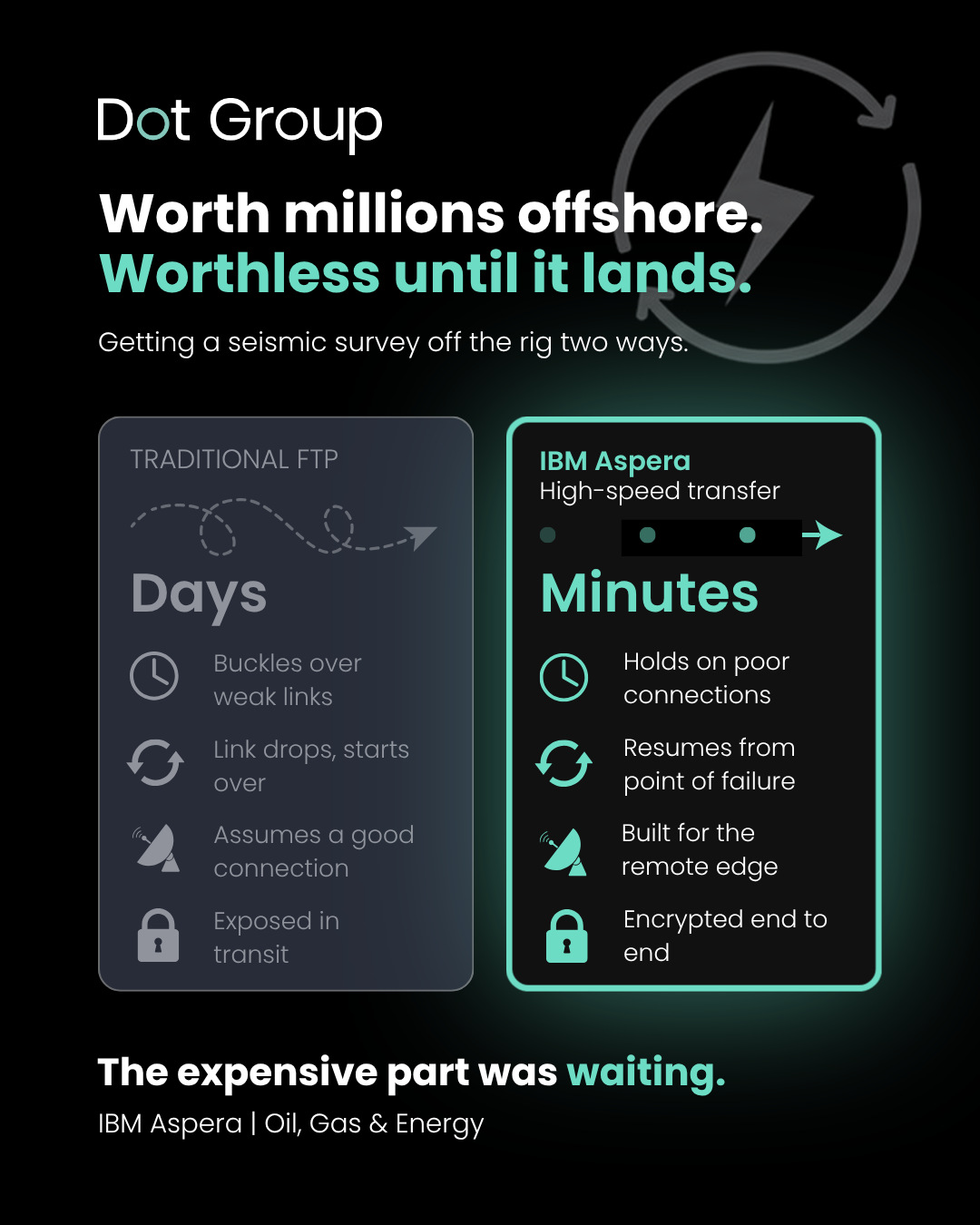
Energy data has a particular cruelty to it: it’s enormous and it’s created exactly where moving it is hardest. Seismic surveys, reservoir models, sensor telemetry from rigs and turbines – all of it runs to terabytes, and much of it originates offshore, in deserts, or at remote sites where bandwidth is thin and unreliable. Meanwhile the cost of waiting is brutal: rig time, vessel time, and exploration windows are measured in eye-watering daily rates, so every day a dataset spends in transit is a day of expensive assets sitting idle. The tools much of the sector defaults to, FTP, or physically couriering drives across borders, buckle under the file sizes and fail over exactly the kind of long, fragile connections these sites depend on.
The worries that follow the data home.
Will it get there before it costs us? Idle rig and vessel time is ruinously expensive, so a slow transfer isn’t an inconvenience, it’s a line on the budget. Will it survive the journey? A corrupted seismic set from a survey that cost millions to acquire can’t simply be re-shot. Can we move it from where it actually is? Remote, low-bandwidth, high-latency sites are where this data is born, and most transfer tools quietly assume a good connection. And is it secure end to end? Exploration data is among the most commercially sensitive information a company owns. In the wrong hands, it’s a competitor’s advantage.
For an industry that spends fortunes acquiring data, the bottleneck is too often the simple act of getting it home.
The technology the majors already run on.
The fix has existed for years. The largest energy companies and survey specialists have relied on it for exactly this. IBM Aspera’s patented FASP™ protocol uses the full available bandwidth regardless of file size, distance, or how poor the connection is which is the whole point when your data starts life on a vessel in the North Sea. Interrupted transfers resume from the point of failure rather than starting over, so a dropped satellite link doesn’t mean re-sending a terabyte from scratch. Everything is encrypted in transit and at rest with integrity verification on every block, so commercially sensitive exploration data stays protected the entire way.
There was a time this was realistically only an option for the supermajors. The old volume-based pricing climbed steeply with the sheer scale of seismic data, and that ruled it out for most. That maths has changed. IBM has removed volume-based pricing, so the capability the majors depend on is now within reach of the independents and service companies moving the very same files – the performance unchanged, the cost barrier gone.
How OvationData moves hundreds of terabytes a week.
OvationData is the global leader in data management for oil and gas — storing, processing and safeguarding the colossal seismic and well-log datasets that exploration depends on, some worth upwards of a billion dollars. Its customers send raw data in from distant exploration sites with poor infrastructure, expect processed data back, and hold OvationData to firm SLA deadlines — all while individual files can exceed 100 terabytes. Traditional transfer couldn’t meet that on speed, scale, or the state of the connections involved.
With Aspera as the high-speed backbone of its entire data management system, OvationData now transfers hundreds of terabytes each week between sites, pulls vast files in from remote locations over poor networks, and guarantees delivery ahead of SLA deadlines thanks to fast, predictable transfers.
SourceAspera has made my delivery model much safer, more streamlined, and more efficient.
Account Manager, OvationData
The part that makes it work in the field.
Aspera is the capability; making it work at the literal edge of the network is the craft. It has to slot into environments that weren’t built for it – remote sites, mixed connectivity, existing survey and interpretation workflows – and keep running when the connection is anything but ideal. That’s where Dot Group comes in: sizing the right deployment for the conditions, wiring high-speed transfer into the tools your geoscientists and engineers already use, and supporting it long-term, so the data gets home and nobody’s waiting on a courier.
Where's your data stranded right now?