
IBM Aspera for Engineering & Manufacturing
IBM Aspera | Engineering & Manufacturing
The design is finished in one country, built in another, and refined in a third. All before Friday.
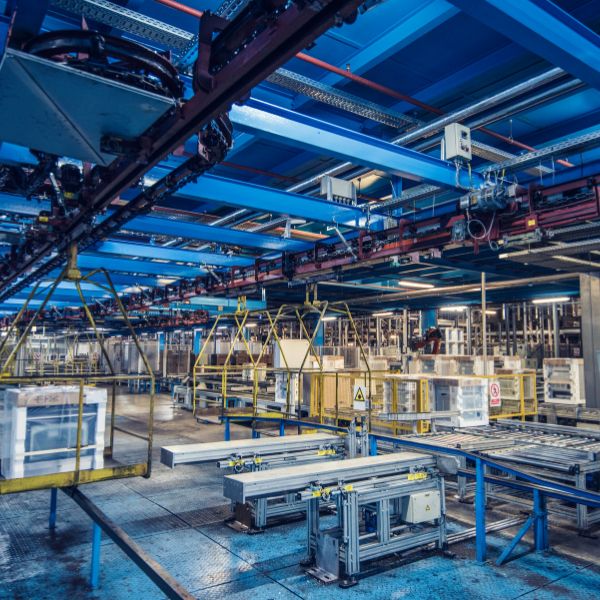
Modern manufacturing is a global relay race. The product only moves as fast as the data behind it.
A single product today is designed, simulated, prototyped and manufactured across a chain of sites that might span three continents. CAD models, simulation results, test data, machine instructions, the digital twin of whatever you’re making has to move between those sites constantly, and it’s getting bigger with every generation of the product. When that data stalls in transit, the whole chain waits: an engineer in one time zone idle until a file lands from another, a production line paused for instructions that haven’t arrived. In manufacturing, a slow file transfer doesn’t just delay data. It delays the thing itself.
Bigger models, more sites, less patience.
Engineering data has quietly outgrown the tools used to move it. A modern CAD assembly, a full crash simulation, a set of high-resolution inspection scans, Each runs to gigabytes, and a single project generates thousands of files that all need to be in sync across a distributed team. Globalised supply chains mean those files cross borders routinely, between design houses, manufacturing partners and test facilities that rarely share a network. And competitive pressure has compressed every timeline, so the tolerance for “it’s still uploading” has all but vanished. FTP and consumer file-sharing were never built for this. They choke on the volume, stumble over distance, and turn a multi-site collaboration into a queue.
What’s actually at stake when the data stalls.
Does the whole chain wait on this one transfer? When sites depend on each other’s outputs, a slow file doesn’t inconvenience one team, it idles the next one down the line. Is every site working from the same version? A half-synced design or an out-of-date model isn’t a delay, it’s a defect waiting to be built. Can our partners actually receive it? Collaboration means moving large files to suppliers and contractors on networks you don’t control. And is our IP safe in transit? Product designs and process data are the crown jewels. Exactly what a competitor, or a counterfeiter, would most like to intercept.
The irony of advanced manufacturing is that the most sophisticated product in the room can still be held up by the least sophisticated way of moving its data.
The capability the global manufacturers lean on.
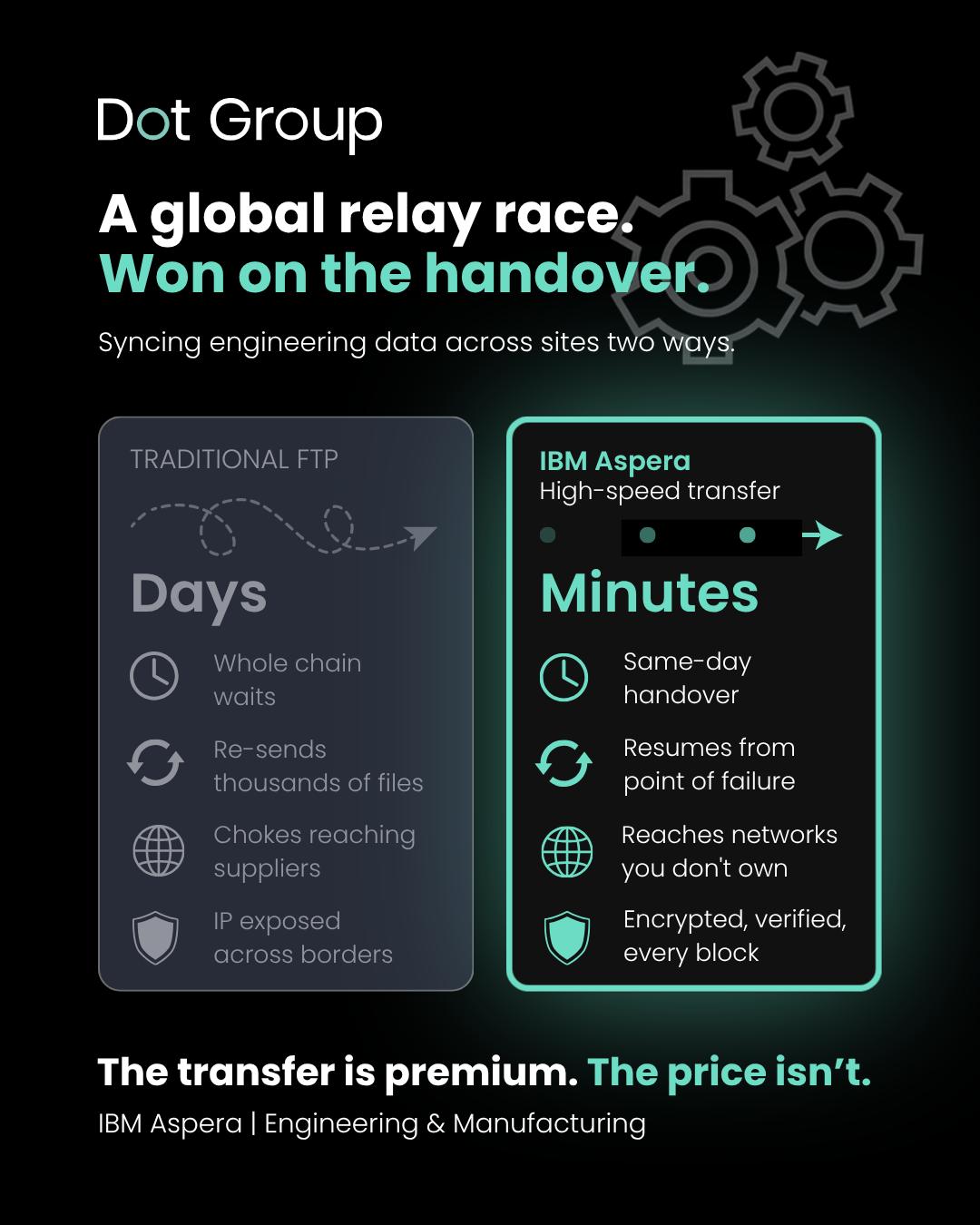
This problem was solved years ago. The world’s largest manufacturers have moved their engineering data this way for a long time. IBM Aspera’s patented FASP™ protocol uses the full available bandwidth regardless of file size, distance or network quality, so a CAD assembly that crawled between sites moves at the speed the project actually needs. Interrupted transfers resume from the point of failure, not the beginning, which matters when you’re syncing thousands of files across time zones. And everything is encrypted in transit and at rest with integrity verification on every block, so your designs stay yours the whole way.
For a long time, the cost of moving data at that scale meant only the largest manufacturers could justify it – the old volume-based pricing rose sharply as file volumes grew. That’s no longer the case. IBM has removed volume-based pricing, putting the same capability the global players rely on within reach of the mid-size manufacturers and engineering firms working to exactly the same deadlines, against exactly the same file sizes.
How Jabil moved 124GB across the globe in under five hours.
Jabil, one of the world’s largest manufacturing solutions providers, needed to move enormous volumes of design and production data between its global sites quickly, reliably, and without the delays that traditional transfer imposed on a business operating around the clock and around the world.
With IBM Aspera, Jabil transferred 124GB across 3,400 files from several sub-folders in under five hours, turning what had been a multi-day bottleneck into a same-day handover between sites.
SourceAs a company dedicated to providing better, faster and cheaper services to our customers, we knew we needed a new solution more aligned with our service objectives. We found the answer in Aspera. The solution's speed, security and ease of use enable us to provide quality service to our valued customers.
Director of IT, Jabil
The part that that turns it into a workflow.
Aspera is the engine; building it into how a manufacturing operation actually runs is the craft. It has to connect sites, partners and systems that were never designed to talk to each other, and fit into PLM and engineering workflows your teams already depend on without becoming one more tool nobody wants to use. That’s where Dot Group comes in: designing the right deployment for a distributed operation, wiring high-speed transfer into the pipeline your engineers already work in, and supporting it long-term, so the data keeps pace with the product.
Which site is waiting on a file right now?