
IBM Aspera for Gaming
IBM Aspera | Gaming
The game is 150 gigabytes, the studio is on four continents, and launch day moves for no one.

Modern games are among the largest files anyone ships to the public. Building them – and patching them, forever – is a logistics problem first.
A modern AAA game is a colossal, constantly moving body of data. Hundreds of gigabytes of assets – textures, models, audio, cinematics, motion capture – built by studios, contractors and outsourcing partners scattered across the globe, all working on the same titanic project at once. Then it ships to millions of players simultaneously, and the work doesn’t stop: patches, expansions, live-service updates and hotfixes keep flowing for years after release. At every stage, enormous files have to move between collaborators during development, and out to the world at launch and beyond. When that movement is slow, the build waits, the patch waits, and a player somewhere is staring at a progress bar instead of playing.
Built everywhere, shipped everywhere, never finished.
Game data has outgrown the tools most studios reach for. A single asset drop between a studio and an outsourcing partner can run to tens of gigabytes; a full build is a small mountain of files that has to stay in sync across teams that rarely share a network or a time zone. Co-development is now the norm, so the same project is touched by collaborators on opposite sides of the planet, all needing the latest version, fast. And live-service has turned launch from a finish line into a starting gun – the data keeps moving long after release, every update another global distribution problem. FTP and consumer cloud tools sag under this: they’re slow over distance, fragile on big transfers, and turn collaboration into a queue.
The friction that shows up at every stage.
Are collaborators waiting on the latest build? When a studio in one country can’t start until assets land from another, the whole production moves at the speed of the slowest transfer. Will a massive asset drop actually complete? A multi-gigabyte transfer that fails three-quarters through, over a long international link, is a day lost and a deadline closer. Can we ship at launch scale? Pushing a build or a day-one patch to global partners and platforms is a transfer challenge measured in terabytes against a fixed date. And is the unreleased build protected? A leaked game, or leaked assets, ahead of launch is a commercial disaster and a community-management nightmare.
Players will forgive a lot, but never a download bar. And that bar starts long before they ever see it, somewhere in a pipeline moving the game across the world.
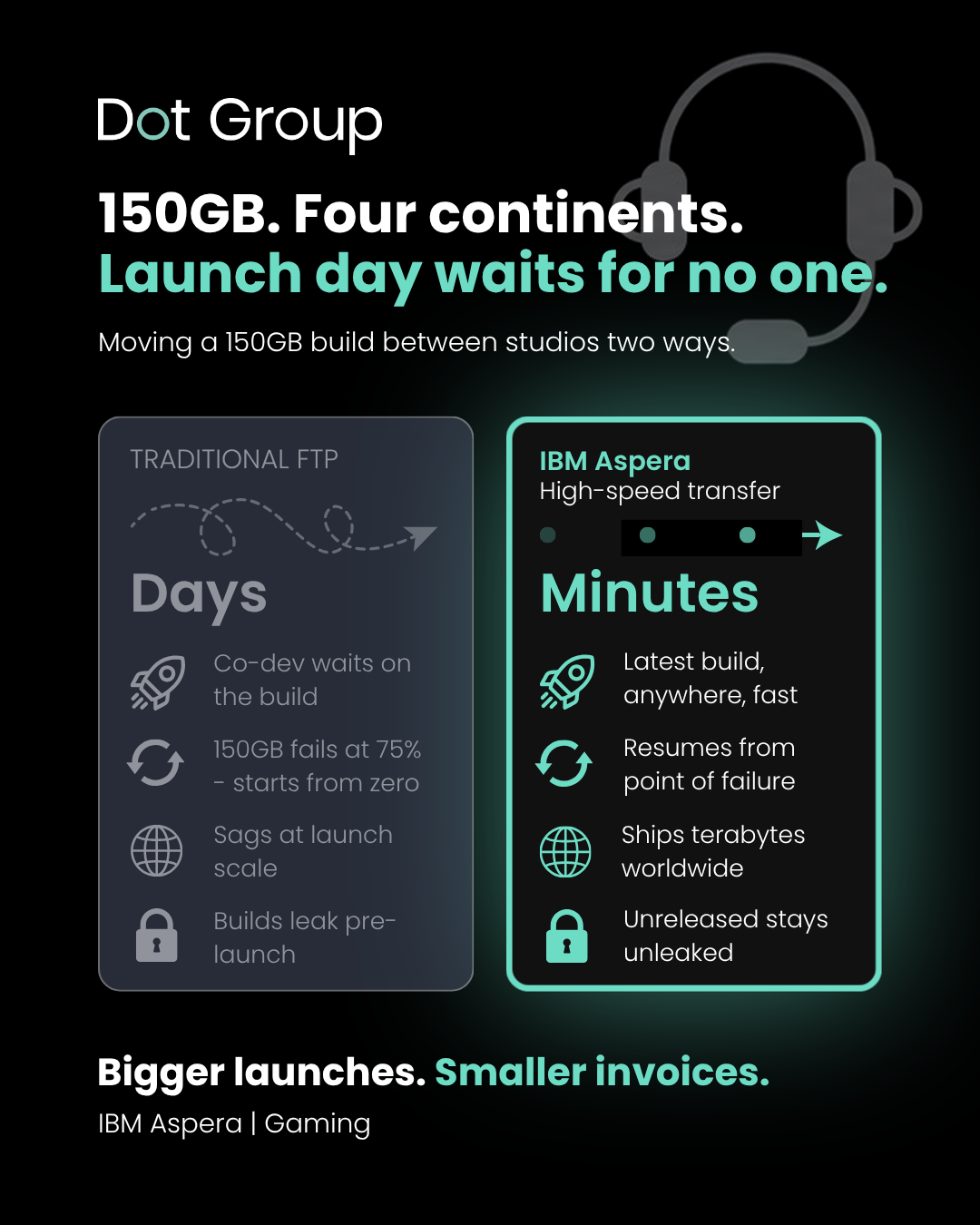
This is how the big builds actually travel.
The biggest studios and publishers have moved their builds and assets this way for years. IBM Aspera’s patented FASP™ protocol uses the full available bandwidth no matter the file size, distance or network condition, so an asset drop that crawled between continents arrives in a fraction of the time. Interrupted transfers resume from the point of failure rather than restarting which, on a 50GB build over an international link, is the difference between a hiccup and a lost afternoon. And everything is encrypted in transit and at rest with integrity verification on every block, so an unreleased title stays unleaked.
For years, moving data at this scale was something only the biggest publishers could comfortably justify. The old volume-based pricing rose sharply as the gigabytes piled up, and games pile up gigabytes faster than almost anything. That barrier is gone. IBM has removed volume-based pricing, so the capability the major studios depend on is now genuinely within reach of the independent studios, co-dev partners and outsourcing houses moving the very same builds – same speed, same security, without the cost that used to put it out of reach.
Where a smooth pipeline is actually won.
Aspera is the engine; turning it into a pipeline a studio actually wants to use is the craft. It has to slot into the build systems, asset-management tools and outsourcing workflows your teams already live in. And keep performing as the project balloons toward launch and the live-service grind beyond it. That’s where Dot Group comes in: shaping the deployment to fit how your studio really works, embedding high-speed transfer into the pipeline your developers already use, and supporting it through launch and every update after. So the data never becomes the reason the build, or the patch, is late.
What's the transfer standing between your team and the build they need?
Tell us where your assets and builds get stuck – between studios, or on the way to players. We’ll show you what it looks like when the file is never what’s holding up the game.