
IBM Aspera for Banking & Financial Services
IBM Aspera | Banking & Financial Services
In finance, the data is the asset, the liability, and the thing the regulator wants to see. All at once.

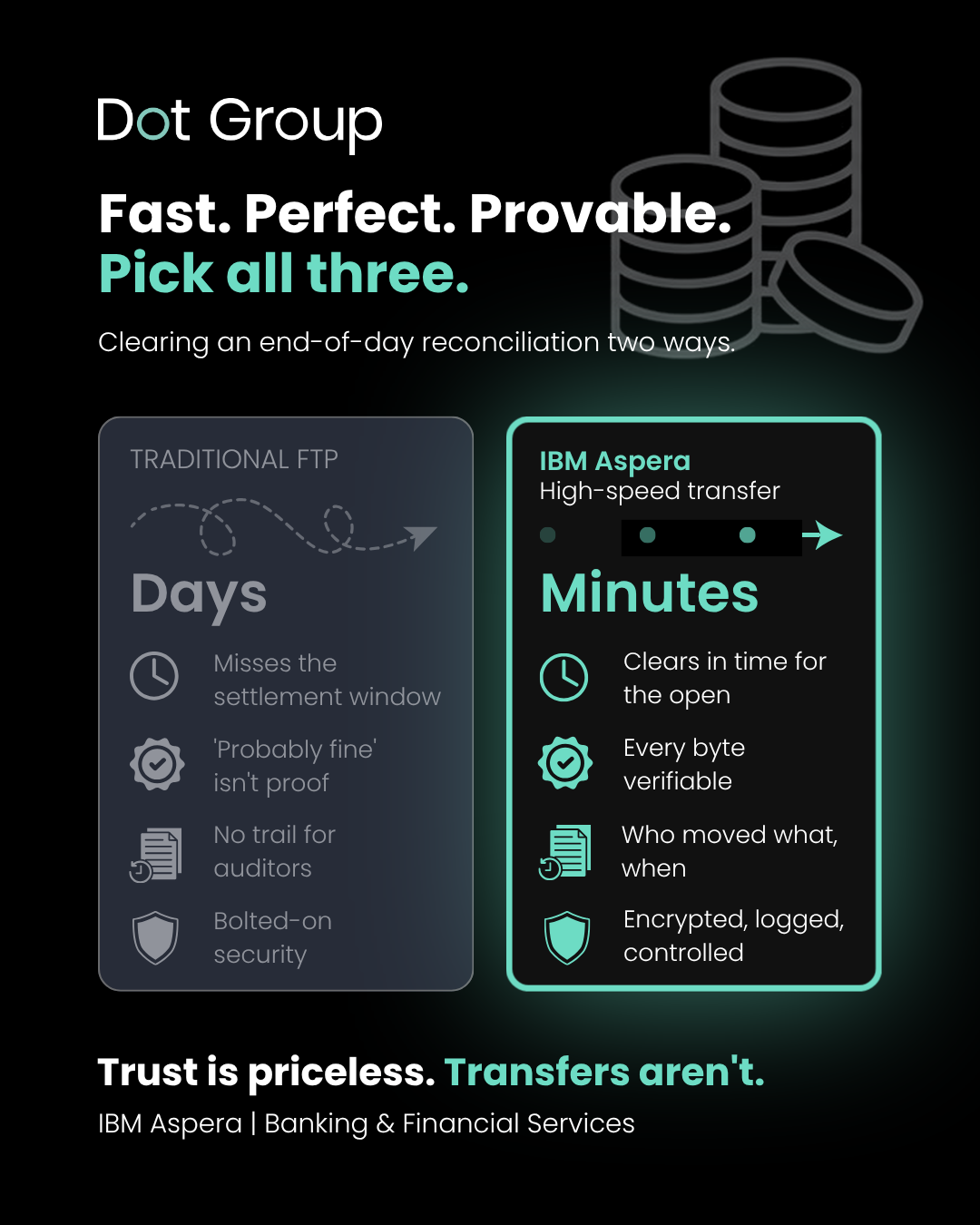
Financial data has to move fast, arrive perfect, and prove it did both. Most transfer methods manage one of the three.
Banks and financial institutions move enormous volumes of data every day: trade records, risk models, transaction histories, regulatory submissions, end-of-day reconciliations across markets and time zones. Unlike most industries, finance can’t treat data movement as plumbing it never thinks about, because in this sector the transfer itself is scrutinised. It has to be fast enough to hit a market deadline, exact enough to survive an audit, and secure enough to satisfy a regulator who assumes the worst. When any of those slips, the cost isn’t a delayed project. It’s a missed window, a compliance breach, or a number that doesn’t reconcile.
The volumes climbed, and so did the scrutiny.
Financial data has grown relentlessly – richer risk models, deeper transaction histories, ever-expanding regulatory reporting that demands more detail and faster turnaround every year. At the same time, the rules around moving it have tightened: data residency requirements, audit trails, encryption mandates, and reporting deadlines that don’t flex for a slow upload. Much of the sector still leans on legacy file-transfer infrastructure, managed FTP servers and batch processes built decades ago, that strains under modern volumes and offers little of the visibility a compliance team now needs. The result is a quiet, persistent risk: critical data moving on systems that were never designed for today’s speed or today’s scrutiny.
Where the real exposure sits.
Will it clear before the window closes? Settlement, reporting and reconciliation run to hard deadlines, and a transfer that misses one has consequences that aren’t measured in inconvenience. Can we prove it arrived intact? In finance, “probably fine” isn’t a standard. Every byte has to be verifiable, because a single corrupted record can invalidate a report. Does it satisfy the regulator? Encryption, audit trails and data residency aren’t nice-to-haves; they’re the licence to operate. And can we see what’s happening? Compliance teams need visibility into who moved what, when, and whether it succeeded, not a black box.
Finance is the one industry where moving the data slowly isn't just inefficient, it can be non-compliant.
Speed that can survive an audit.
This is well-trodden ground for the institutions that solved it years ago. Major banks and financial firms have relied on high-speed, auditable transfer for exactly these pressures. IBM Aspera’s patented FASP™ protocol moves data at the full available bandwidth regardless of size, distance or network condition, so a reconciliation that crawled overnight completes in time for the open. Transfers resume from the point of interruption rather than restarting, and every block is verified for integrity. So “it arrived complete” is something you can demonstrate, not just hope. Encryption in transit and at rest, granular access controls, and detailed transfer logging give compliance teams the security and the audit trail the regulator expects. The same backbone that moves petabytes of seismic data for the energy majors handles financial data with the precision and accountability this sector demands.
There was a time this calibre of transfer was realistically the preserve of the largest institutions. The old volume-based pricing scaled steeply with the data volumes big finance generates. That has changed. IBM has removed volume-based pricing, putting the same secure, auditable capability the major banks rely on within reach of the mid-tier institutions, asset managers and fintechs held to exactly the same regulatory standard – the performance and compliance unchanged, the cost barrier removed.
Making it answer to the regulator, not just the deadline.
Aspera is the capability; making it fit a regulated environment is the craft. It has to integrate with core banking systems, reporting pipelines and existing security and compliance frameworks. And produce the visibility and audit trail your risk and compliance teams answer to. That’s where Dot Group comes in: designing a deployment that satisfies both the performance need and the regulatory one, wiring high-speed transfer into the systems your teams already operate, and supporting it long-term. So the data moves at the speed of the market and stands up to the scrutiny of the regulator.
Which deadline are you cutting too close - the market's or the regulator's?
Tell us where your financial data gets stuck, and what it has to prove when it arrives. We’ll show you what it looks like when fast and compliant stop being a trade-off.