
By Simon Parkinson, Managing Director, Dot Group

In nearly thirty years of working with organisations on their data challenges, I’ve learned that the most important conversations rarely start with technology. They start with frustration.
Not dramatic, headline-grabbing frustration. The quieter kind. The kind that surfaces when a leadership team realises their data estate has grown faster than their ability to use it. When an AI initiative that looked promising in the lab can’t make it into production. When a business that has invested heavily in modernisation still can’t move at the speed the market requires.
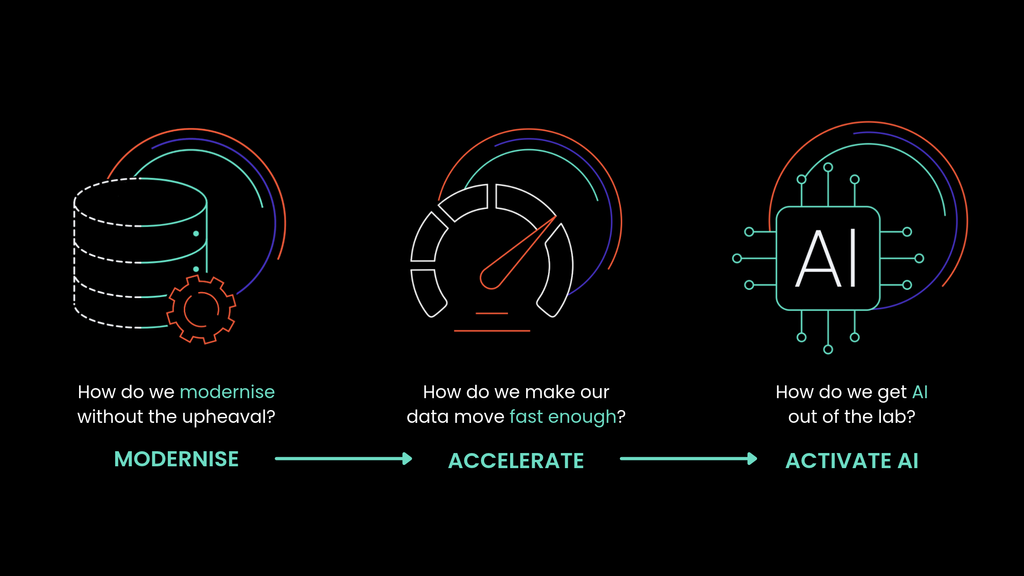
These conversations happen constantly. And over the past year, as we’ve worked to sharpen how Dot Group presents itself and what we stand for, I’ve noticed that almost every one of them comes back to one of three questions. At its heart, it’s a question of data and AI strategy and whether organisations have one that can actually deliver.
How do we modernise without the upheaval?
Legacy infrastructure is rarely the result of bad decisions. Most of the systems organisations are trying to move away from were built by talented people solving real problems with the best tools available at the time. The challenge is that those systems were never designed for what organisations need to do today – real-time analytics, AI workloads, cloud-native scale.
The instinct is often to replace everything. In our experience, that’s rarely the right answer. Wholesale replacement carries enormous risk, disrupts the teams who rely on those systems, and frequently takes longer and costs more than anyone anticipated.
What works better is a structured approach: understand the estate properly before proposing anything, identify what’s genuinely holding the organisation back versus what can be evolved in place, and design a migration path that preserves what matters whilst clearing the path for what comes next. We’ve done this across financial services, retail, logistics, and manufacturing. And the organisations that get it right are invariably the ones that treat modernisation as a programme rather than a project.
This is what we mean when we talk about Modernise as a practice. Not ripping out and replacing, but helping organisatio ns optimise and migrate to modern, cloud-native architecture in a way that their teams can absorb and their business can sustain.
How do we make our data move fast enough?
The second question is about speed and it comes up in almost every sector we work in. Data that arrives too late to act on isn’t just inconvenient. In financial services, it’s the difference between stopping a fraudulent transaction and processing it. In retail, it’s the difference between a recommendation that’s relevant and one that’s already out of date. In logistics, it’s the difference between exception handling in real time and discovering problems in the next day’s report.
Most organisations aren’t short of data. They’re short of data that moves at the speed their business actually operates.
This is where real-time streaming architecture becomes critical and where our work with Confluent and SingleStore, both part of IBM’s extended data portfolio, has been transformative for the clients we’ve helped. Confluent moves data the moment it’s created, streaming it continuously rather than in batches. SingleStore provides the high-performance analytical layer that makes it queryable in sub-seconds, handling transactional and analytical workloads simultaneously without the latency penalty that traditional architectures introduce.
Together, they close the gap between data that exists and data that’s useful. And in our experience, once organisations see what’s possible when those two things are the same, the conversation about their data architecture changes completely.
This is the heart of what we mean by Accelerate.
How do we get AI out of the lab?
The third question is the one I hear most urgently right now. AI has moved from a future possibility to a present expectation faster than most organisations anticipated. Boards want to know when AI initiatives will deliver. Technology teams are under pressure to move from experimentation to production. And the gap between the two remains stubbornly wide.
In almost every case, the bottleneck isn’t the model. It isn’t the use case. It’s the data foundation underneath. AI in production requires data that is trusted, governed, and moving fast enough for the AI to work with. Without those foundations, AI stays in the lab. Not because the organisation lacks ambition, but because the infrastructure can’t support it.
Activating AI isn’t a technology decision. It’s a data architecture decision. And it requires the same rigour that any serious data programme demands: understanding the current state honestly, designing for the target architecture rather than patching the existing one, and delivering it in a way that the business can actually operate and scale.
Data you can actually trust
Underpinning all three areas is a question that doesn’t always get asked early enough: how do you know the data is right?
Real-time data moving at speed, AI operating at scale, legacy systems moving to the cloud – none of it delivers what it promises if the data underneath can’t be trusted. Security, governance, and data quality aren’t a layer you add at the end. They’re the foundation every other part of the architecture depends on.
At Dot Group, we treat data security and governance as a horizontal capability across every engagement, not a separate workstream, and not an afterthought. Because the organisations that get this right aren’t just better protected. They’re better positioned to move faster, with confidence, when it matters most.
One approach. Nearly thirty years in the making.
What’s changed at Dot Group is how clearly we’ve articulated these three areas – Modernise, Accelerate, Activate AI – as the organising framework for everything we do. What hasn’t changed is the way we work.
We spend time understanding the problem before we propose anything. We design solutions for the specific environment, not a standard package adapted to look like it fits. We deliver, and we stay with it through the complications that every real project encounters. And we support what we build long after go-live, because that’s where the value is actually realised.
The full range of technology we work with from IBM’s core data portfolio to Confluent and SingleStore is set out on our [Technology pages]. But the technology is always the means, not the message. The message is that we’ve been solving difficult data problems for nearly thirty years, and we know how to get it right.
If any of the three questions above sound familiar, please get in touch.